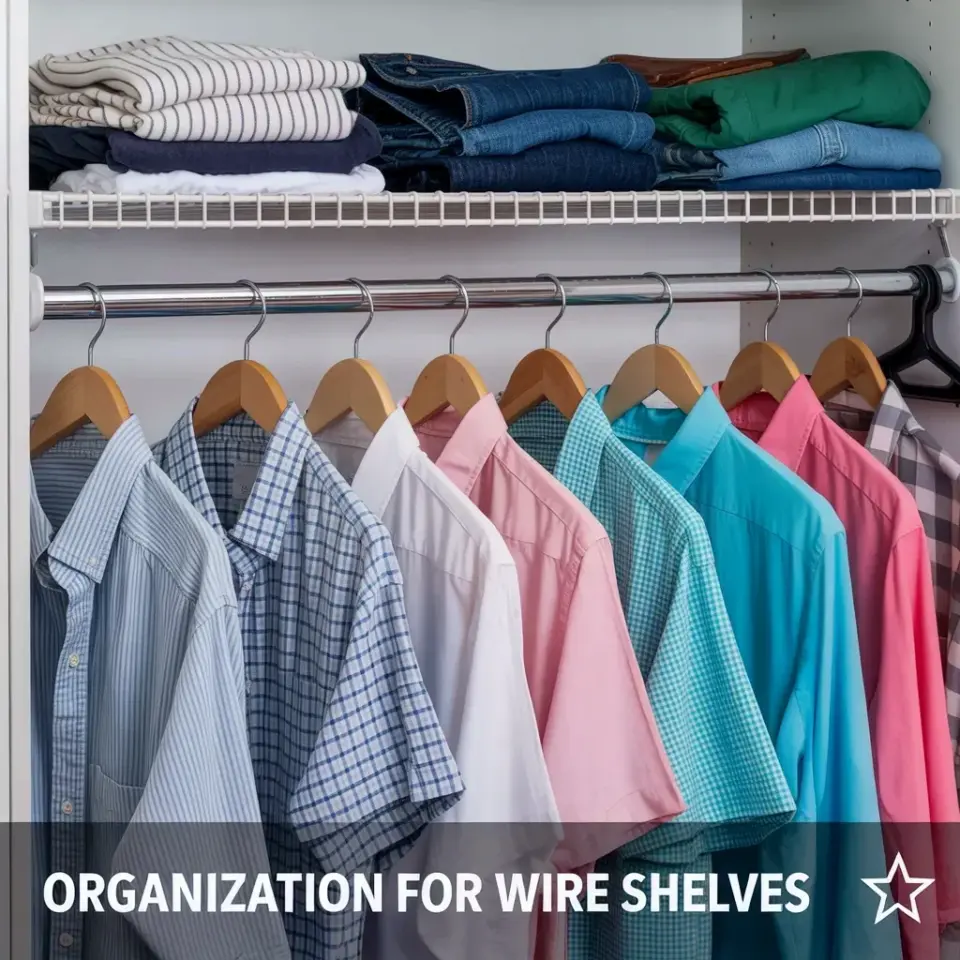
It’s that weird pre-holiday window where the rest of your house feels borderline fine, but the closet is screaming at you. You pull a shirt, a stack collapses, and suddenly you’re having a 7 a.m. staring contest with your own chaos. This wire shelf closet organization before and after is proof you don’t need a custom built-in or a contractor to fix it. You just need a folding system, a color story, and maybe 45 minutes of stubbornness. The photo I’m referencing has it all: the top shelf holding a striped gray and white blanket, dark denim, and a green piece, then the rod below with shirts on wooden hangers. And honestly? The color-coordinated folding does everything.
**Why Wire Shelves Deserve a Second Look**
Wire shelves get a bad rap because they sag and they show every dust bunny that ever lived. But here’s the thing: they also come with you when you rent. They don’t require a drill, a level, or a prayer that you don’t hit a pipe. The real problem isn’t the shelf material, it’s that we treat them like a dumping ground instead of a display surface.
I’ve seen people rip out perfectly good wire shelving in a fit of Pinterest rage. Don’t do that yet. This small closet organization fix keeps the original system and changes everything else: how you fold, what you hang, and what you admit you’ll never wear again.
The before photo probably had a mountain of mixed textures and no visual rhythm. The after is calm. It’s controlled. And the only thing that changed is the method.
**Start With a Hard Edit (The Painful but Necessary Step)**
Ok so let’s talk about the part nobody wants to hear. You can’t organize clutter, you can only organize the stuff you actually keep. If you have 14 faded t-shirts from 5K races you didn’t finish, fold them into the donation bag, not onto the shelf.
Pull everything out. Every single item. Pile it on the bed and sort into three categories: keep, donate, and the complicated “maybe” pile. For the maybe pile, flip a hanger backward. If you don’t wear it in 30 days, it goes. That’s the whole test.
You’re aiming for a shelf that has room to breathe. The photo shows folded jeans stacked neat, not jammed sideways. That only works if you’re not fighting for space.
**The 20-Minute Fold That Changes Everything**
Here’s a mild confession from a real human blogger: I learned this fold out of spite after a laundry day argument. You lay the item face down, tuck the sleeves in at an angle, then fold the sides inward to create a rectangle. It takes one second longer than the lazy roll but it stands up on the shelf like a soldier.
The way the shirts are arranged on that lower rod in the photo? They’re not hung, they’re folded over the rod. It’s like the missing link between hanging and stacking. Fold the shirt into that neat rectangle, drape it over the wooden hanger, and the collar sits perfectly flat.
For jeans, fold them in half lengthwise, then in thirds, and stack vertically so you can actually see each pair without wrecking the pile. The blanket? Roll it tight, tuck the ends under, and place it as the anchor of the top shelf. It’s the visual weight that holds the whole composition together.
**Color Coordination: The Shortcut You’re Overthinking**
Some people treat color coordination like a medical procedure. It’s not that deep. You’re just grouping like colors together so the eye sees a pattern instead of noise. The photo has light blue, white, pink, and turquoise all sorted. It works because the palette is tight, not because it took a design degree.
Here’s my practical tip: sort the clothes into a rainbow or a gradient only if that feels natural to you. If not, just group by color family. Whites with whites, blues with blues, and let the checkered patterns act as the accent pieces.
– Place heaviest or darkest items on the bottom shelf.
– Keep the lightest colors toward the left or center.
– Use the checkered items as intentional pops, not random chaos.
– If a color group is too big, you kept too much. Cut it.
Also, the green garment on the top shelf works because it’s isolated. One green piece reads as a choice. Twelve green pieces reads as a wardrobe crisis.
**Make the Hanging Rod Earn Its Keep**
Hanging space is prime real estate, so don’t waste it on things that belong in drawers. Heavy sweaters stretch on hangers. T-shirts should almost never hang unless they’re oversized or doing the fold-over trick like in the photo. The wooden hangers aren’t just pretty, they’re thicker, so they grip the fabric and stop the shoulder divots.
Use the rod for the items that truly need it: button-downs, structured jackets, and anything that wrinkles if you look at it sideways. The shirts on that bottom rod are arranged by color, but they’re also arranged by sleeve length. Short sleeves, then long sleeves, then the checkered pieces. Small details like that make the whole shelf look intentional without any extra effort.
**Small Closet Math: Bins, Empty Space, and Your Sanity**
If you have a small wire shelf closet, you already know that floor space is a myth. The trick is using the vertical drop. Stack a bin on the top shelf for off-season items or random hardware. Use a slim hanging organizer on the inside of the door for accessories if you must, but don’t overstuff it.
A few empty pockets of space are fine. Actually, they’re the point. The after photo succeeds because there’s breathing room. If every inch is packed, you’re not organized, you’re just storing more stuff badly.
The checkered patterns look intentional because they have space around them. Same goes for your favorite sweater. Give it room and it suddenly looks like a curated product shot instead of a dumpster fire.
**Keep It Alive: The Maintenance Habit That Actually Sticks**
Alright, let’s be real for a second. It’ll look like this for about two weeks, maybe a month if you’re careful. Then laundry happens and the spiral begins. What actually keeps this alive is the one-minute rule: every time you put clothes away, reset the system.
That’s it. No Sunday reset ritual. No 30-minute reorganization every week. Just fix one folded shirt or re-stack one pair of jeans each time you pass by. The photo was staged for a post, sure, but the system behind it is real life. It degrades gracefully.
If you notice a color section exploding, you probably need a purge, not more bins. And if the blanket keeps unraveling, the roll is too loose. Tighten it, tuck the ends, and move on. This is practical stuff, not perfectionism.
The best part of this wire shelf closet makeover? It’s completely reversible. You can change it next season when your palette shifts or when you buy a terrible neon hoodie you absolutely had to have. The fold stays the same. The hangers stay the same. You just swap the colors and you’re done.
So go clear a shelf and try it. Even if it’s just one shelf, not the whole closet. Save this for your next reset day and tag me when it works. You’ll surprise yourself with what twenty minutes of folding can do.
Leave a Comment